Bin continuous data using the equal frequency binning method.
Usage
rbin_equal_freq(data = NULL, response = NULL, predictor = NULL, bins = 10)

# S3 method for class 'rbin_equal_freq'
plot(x, print_plot = TRUE, ...)
Arguments
- data
A
data.frameortibble.- response
Bare column name, character name, or variable holding a character name in
data. A binary variable coded as 0/1, a logical variable, or a two-level factor/character. For a two-level factor the first level is treated as 0 and the second as 1; for character data the two values are sorted and the second is treated as 1. Rows with a missing response are dropped with a warning.- predictor
Bare column name, character name, or variable holding a character name in
data. A numeric predictor variable.- bins
Number of bins.
- x
An object of class
rbin_equal_freq.- print_plot
logical; if
TRUE, prints the plot else returns a plot object.- ...
further arguments passed to or from other methods.
Value
A list of class rbin_equal_freq with the following elements:
bins, a data.frame with one row per group (plus a final row
for missing values when present); method; vars;
lower_cut; and upper_cut.
Details
Groups have approximately equal sizes and never split tied values.
For each k = 1, ..., bins - 1, take the smallest observed value
whose cumulative count reaches k * n / bins, where n is
the number of non-missing predictors (the type-1 empirical quantile).
All observations equal to that value stay in the lower group. The next
distinct observed value is the scoring cut. Repeated cuts and cuts beyond
the maximum are omitted; a message reports the requested and actual
numbers of non-missing bins when fewer bins result. No bin is empty.
Without ties, group sizes differ by at most one observation.
Both the top-level and table lower_cut/upper_cut fields
contain the actual left-closed, right-open scoring intervals. The first
and last intervals extend to negative and positive infinity; gaps go to
the preceding group. rbin_create() reproduces the non-missing
training counts using these intervals.
Missing predictor values form a separate final group, and the equal
frequency groups are built from non-missing values only. As with other
numeric methods, missing predictors produce missing dummy indicators.
Examples
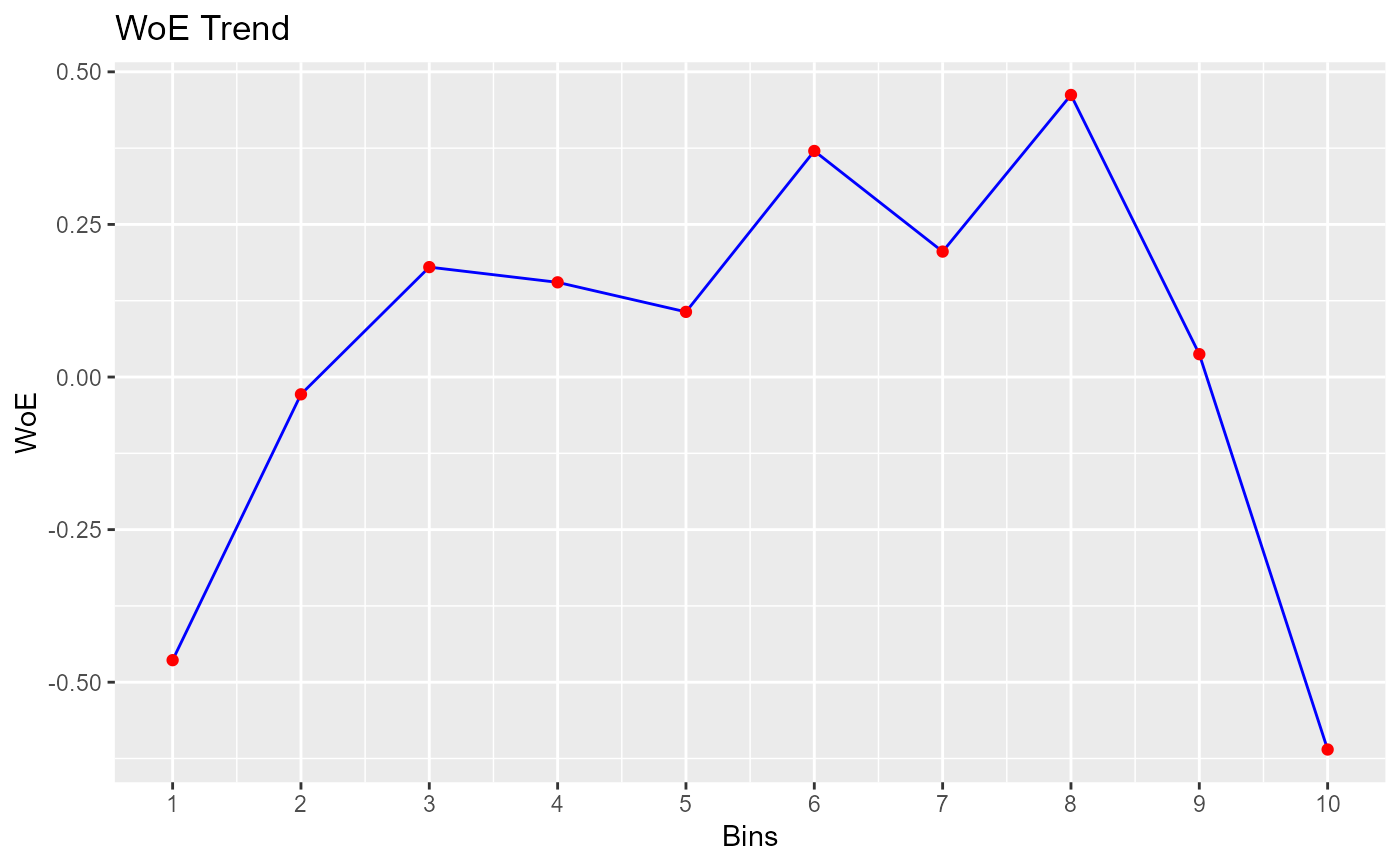
bins <- rbin_equal_freq(mbank, y, age, 10)
bins
#> Binning Summary
#> ------------------------------------
#> Method               Equal Frequency
#> Response             y
#> Predictor            age
#> Bins                 10
#> Count                4521
#> Goods                517
#> Bads                 4004
#> Entropy              0.5
#> Information Value    0.11
#>
#>
#>    lower_cut upper_cut bin_count good bad  good_rate         woe           iv
#> 1       -Inf        30       521   85 436 0.16314779 -0.41201528 2.287466e-02
#> 2         30        32       386   45 341 0.11658031 -0.02178628 4.086635e-05
#> 3         32        35       582   57 525 0.09793814  0.17334073 3.617176e-03
#> 4         35        37       374   38 336 0.10160428  0.13251873 1.380198e-03
#> 5         37        40       497   44 453 0.08853119  0.28469623 7.980172e-03
#> 6         40        43       396   37 359 0.09343434  0.22539821 4.078267e-03
#> 7         43        47       461   43 418 0.09327549  0.22727505 4.823562e-03
#> 8         47        52       474   41 433 0.08649789  0.31015940 8.944433e-03
#> 9         52        57       441   47 394 0.10657596  0.07919704 5.933844e-04
#> 10        57       Inf       389   80 309 0.20565553 -0.69569162 5.396205e-02
#>      entropy
#> 1  0.6417872
#> 2  0.5194505
#> 3  0.4624254
#> 4  0.4740605
#> 5  0.4315480
#> 6  0.4478305
#> 7  0.4473095
#> 8  0.4246709
#> 9  0.4895008
#> 10 0.7330960

# plot
plot(bins)